By Siddharth Borderwala
Published
16 min read
What is brand management? Definition, jobs and real examples
The jobs inside brand management, six dated examples from Coca-Cola to Meta, one decision worked from signal to measure, strategic, digital and corporate brand management, and what changes when AI agents make the assets.
TL;DR
Brand management is the ongoing work of deciding what a brand stands for and how it looks and sounds, then keeping every asset true to those decisions as products, channels and the company change. It covers strategy, identity, guidelines, approved files, checks, measurement and change. When AI agents make many of the assets, each agent needs the decisions its task depends on, and what it makes needs checking.
What brand management means
Procter & Gamble says it invented brand management in 1931, “to drive a single point of accountability” for each of its brands, and its company timeline credits Neil McElroy with the idea. That is still the most useful definition: one person or team is responsible for what a brand means and for every place it shows up.
The work has three parts. You build the brand, deciding who it is for, what it promises and how it looks and sounds. You maintain it, turning those decisions into guidelines, files and templates, getting them to everyone who makes assets and checking what they make. And you protect it, watching how the brand is used and perceived and changing it on purpose rather than by drift.
Two neighbouring words get mixed up with it. Branding usually means creating the identity, often as a project with an agency and a launch date. Marketing uses the brand to win customers. Brand management starts before the first and continues long after the launch, and it sets the rules marketing works within.
The aim, in the language of Kevin Lane Keller's standard textbook, Strategic Brand Management, is brand equity: the value the name adds beyond the product itself, which shows when people pick it over an equivalent or pay more for it.
The jobs inside brand management
Most definitions list principles such as awareness and loyalty. Those are outcomes. These are the jobs that produce them, and what each one leaves behind:
| Job | What it produces | When it comes up |
|---|---|---|
| Positioning | Who the brand serves, what it offers, how it differs, and the messages that follow | Launch, a new market, a change of strategy |
| Identity | Name, logo, colours, type, voice, imagery and the other elements people recognise | Launch, refresh, rebrand |
| Guidelines | Rules for using the identity, with examples of right and wrong use | Whenever the identity or messaging changes |
| Files and templates | Approved logo files, fonts, photography and templates at source quality | Continuously, as campaigns and products ship |
| Review and approval | Checks of new assets before release, and sign-off where the risk calls for it | Every asset, at different depths |
| Access and training | Onboarding for staff, agencies, partners, and now agents | New hires, new agencies, new tools |
| Architecture | How the company brand relates to product, sub- and acquired brands | New products, acquisitions, spin-offs |
| Measurement | Awareness, consideration and preference tracking, and audits of what is in the market | Quarterly or yearly tracking; audits before big changes |
| Change | Refreshes, renames and retirements, and removing the old version everywhere | A few times a decade, with small edits all the time |
| Protection | Trademark registrations, and responses to misuse and impersonation | Ongoing |
In a large company, a brand team owns positioning, identity and guidelines, while marketing, product teams and agencies make most of the assets. In a startup, the founder or first marketer does all ten jobs, often from one shared document. The jobs stay the same as a company grows. What grows is the number of people, agencies and tools making assets, and so the distance between a decision and the asset that has to follow it.
Brand management examples
Lists of brand management examples tend to name famous brands and their famous campaigns. The more useful examples are decisions: a brand changed something, said why and lived with the result. These six are documented by the companies or by reporting at the time.
| Brand and date | What changed, and why | What it shows |
|---|---|---|
| Coca-Cola, April to July 1985 | Replaced its formula with one preferred in taste tests, then brought the original back as Coca-Cola Classic 79 days later, once its hotline calls had nearly quadrupled. | Equity lives in what people feel about a brand, which a taste test doesn't measure. |
| NASA, 1975, 1992 and 2020 | Introduced the red “worm” logotype, retired it, then brought it back beside the “meatball” insignia, which stays primary. | A decision can be reversed decades later, so the rules have to say which mark does which job now. |
| Dunkin', September 2018 | Dropped “Donuts” from its name, with drinks at about 60% of sales, after trying it on store signs. | The name followed what the business had become, and was tested before the rollout. |
| Mastercard, January 2019 | Showed its circles without the name on cards and at checkout, after more than 80% of people recognised the symbol alone. | The research on recognition came before the simplification. |
| Slack, January 2019 | Replaced its 11-colour logo because it was too easy to apply wrongly. | Even an exact rule fails when the mark is hard to apply. The fix was a mark that is easier to get right. |
| Meta, October 2021 | Renamed the company so Facebook became one of its apps, and began reporting two segments, Family of Apps and Reality Labs. | The company brand and its biggest product brand became two things, each needing its own rules. |
Slack's announcement showed what drift looks like. Its old logo was, in Slack's words, “extremely easy to get wrong”: on any colour but white, at anything but its prescribed 18° angle, or with its colours tweaked, it “looked terrible”. Versions made to compensate meant “every app button looked different”. Slack published its own examples:
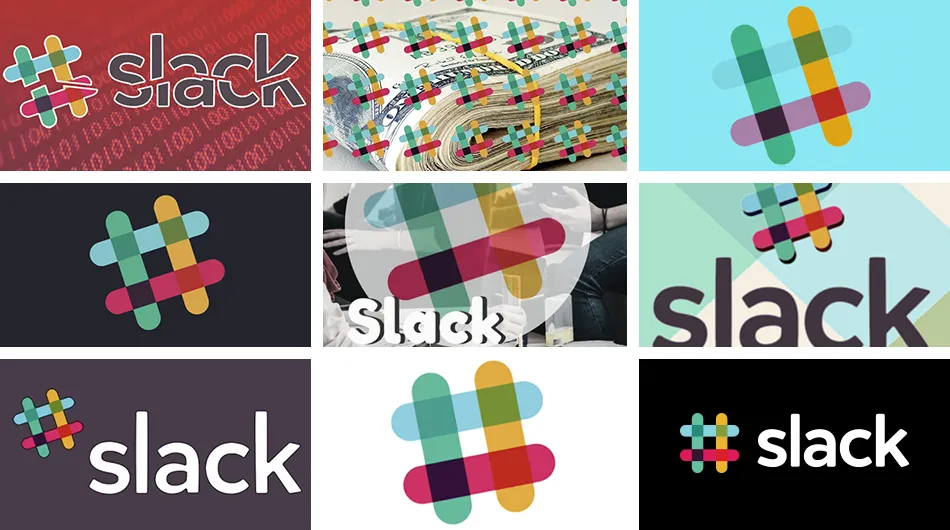
Slack's old logo gone wrong, from Slack's “Say hello, new logo”, January 16, 2019
Every one of these decisions turned into rules that later assets have to follow. Our brand guidelines library, which publishes the logo, colour, type and voice rules of 200 well-known brands, records them as they stand now. Mastercard's page says the Symbol, “without the name, is the primary brand mark”. Slack's says “Don’t use old versions of the Slack logo.” Meta's says “Don’t use the Meta logo to represent Facebook.”
A brand decision, worked through
The table records what each company decided. The harder part of the job comes before that: reading the evidence, choosing between options and knowing in advance what would show you were wrong. Here is Dunkin's rename laid out that way. The signal, the test and the rollout come from NPR's report at the time. The options, measures and failure conditions are ours, the ones a brand manager would write down for a decision like this; Dunkin' didn't publish its test results.
| Step | Dunkin', 2013 to 2019 |
|---|---|
| Signal | Drinks became most of the business. Dunkin' Donuts called itself a beverage company in 2013, when drinks reached 58% of sales, and the share was about 60% by 2018. |
| Hypothesis | A name about donuts held back a brand people mostly visited for coffee. The CEO said a shorter name would keep it relevant as a beverage-led retailer. The untested half: it could do that without losing people who came for donuts. |
| Options | Keep the name and sell drinks harder in advertising. Add a line about coffee under the name. Drop “Donuts”. |
| Intervention | Drop “Donuts”, after a test: one shop in Quincy, Massachusetts, in late 2017, then 30 Boston-area shops and 20 elsewhere from August 2018. The full change came in January 2019, with new store designs, new drinks and drive-through lanes for mobile orders. |
| Measures | In test shops compared with similar shops: visits, drink sales, food sales and whether people still recognised the name. After the rollout: brand tracking on what people think Dunkin' sells. |
| What would prove it wrong | Test shops losing visits or food sales with no gain in drinks, or recognition dropping once the name was shorter. |
Changing the signs on 50 shops first meant the decision could be judged against shops that kept the old name, before every cup, menu, app screen and advert had to change.
Two kinds of measure
A decision like this needs two sets of numbers, and they answer different questions.
Compliance measures ask whether the decision reached the assets. After January 2019, how many signs, cups, menus, app screens, adverts and templates still said Dunkin' Donuts? Audits and asset reviews answer that, and so do counts of how often reviewers sent assets back for the same problem.
Market outcomes ask whether the decision was right. Brand tracking measures awareness, consideration and preference over time. Sales mix, price premium and share of search show up in the business, and some teams now also track how AI assistants describe the brand.
Read them in that order. Weak market numbers say little while many customers still see the old name, and perfect compliance can't rescue a decision customers don't want.
Strategic, digital and corporate brand management
These are three angles on the same job.
Strategic brand management
Strategic brand management is the long-range side: positioning, how the brand will grow and how you will know it is working. Keller and Vanitha Swaminathan's fifth edition (Pearson, 2020) is organised around four stages, with a part of the book for each:
- Develop a brand strategy: what the brand means to customers and how it is positioned against alternatives.
- Design and implement brand marketing programmes: choose brand elements, then the marketing and communications that build on them.
- Measure and interpret brand performance: what customers think of the brand and how that shows up in the market.
- Grow and sustain brand equity: architecture, new products and extensions, and managing the brand over time and across markets.
Dunkin's rename was a first-stage decision about what the brand means, and its shop test belongs to the third.
Digital brand management
Digital brand management covers the brand on websites, apps, social channels and search. It made the job more demanding in one specific way: a mark now has to work at the size of an app icon, on any background, in formats nobody planned for. That is the job of a visual identity system. Both 2019 logo changes above were about that. Slack wanted a logo that could “scale easily, and work better, in many more places”, and Mastercard introduced its name-free symbol with the line “Reinvention in the digital age calls for modern simplicity”.
The newest digital surface is what AI assistants say about a brand. Databricks is hiring a Principal Brand Content & AI Search Visibility, whose job includes tracking how the brand appears in AI answers.
Corporate brand management
Corporate brand management is the company's own brand and the relationship between it and the brands it owns. That relationship is called brand architecture, and it has a chapter of its own in Keller's book. There are three common shapes:
- One brand on everything, with products named under the company brand.
- A house of brands, where products carry their own names. P&G sells Tide, Pampers and Gillette, not P&G detergent.
- Endorsed brands, where a product keeps its name with the owner's beside it. Slack now carries “from Salesforce” on slack.com, and Mailchimp's logo is the Intuit Mailchimp lockup.
Meta's 2021 rename separated the company brand from its oldest product, so Facebook became one app among several under Meta. Changes like that create rules about which logo goes where; the agent example below shows one arriving in a task.
What a brand management system is
A brand management system is how decisions like Dunkin's get made, recorded and carried into the assets that follow. The phrase has two meanings, and pages that define it often blend them.
The older meaning is the organisational system P&G started in 1931: named owners, a process for decisions and a way of holding each brand to them. The newer meaning is software: a digital asset management (DAM) library, a guidelines portal, template tools, approval workflows and brand monitoring. A team may run several of these, and the software only works if the organisational part exists. Many teams now call the working whole a brand system: the decisions, rules, files and process that keep a brand current. Keller's textbook adds a narrower use in a chapter titled “Developing a Brand Equity Measurement and Management System”: the tracking that tells you whether the brand is working.
Whichever tools you use, every brand management system needs the same parts:
A brand management system
- An owner for each kind of decision: positioning, identity, voice, claims and architecture.
- Current rules written so that someone else can apply them, with examples of right and wrong use.
- Approved files at source quality: vector logos, font files and original photography.
- A check before assets ship, with the depth matched to the risk.
- A record of what changed, when and why.
- A way for everyone who makes assets, including agents, to get the current version.
- Both kinds of measure: whether assets follow the decisions, and whether the decisions are working.
For software, our comparison of brand management tools for AI agents covers asset libraries, template platforms and brand context. If your files live in a DAM, this guide explains what agents can and can't get from it.
What changes when agents make the assets
Getting the current version to everyone used to mean staff and agencies. Now it also means the agents in Claude, ChatGPT, Cursor and the tools a company builds itself, and hiring managers have started writing that into job ads. Checkr wants its next creative director to judge when AI-made assets are off-brand or need a person to step in (job posting). Lovable wants launch workflows where, “When the scope changes, the change propagates to every asset that mentions it” (job posting).
Access, review and change are three jobs from the table, now adapted for agents. An agent usually starts each task without last week's corrections and can't ask the brand manager down the hall, so it needs the decisions that apply to its task, with the real files, every time. Brand guidelines vs brand context explains why that is a selection rather than the whole guide.
One architecture rule, from Brief to slide
Rainbrand is built for this part of brand management. It keeps a brand's identity, guidance and files as shared context for agents, next to the guidelines site or DAM a team already has. An agent connected to it requests a Brief for each task: the guidance and files from the brand that apply to that task. A Review checks an image of the finished asset against the brand and returns a verdict and a short reason for each check, such as colour, typography, logo and copy.
To see Meta's 2021 decision reach an asset, we used the copy of Meta's brand in our account, added from about.meta.com for our Meta brand guidelines page. On November 15, 2026 we requested a Brief for a concept: the opening slide of an onboarding deck for new Meta employees, titled “One company, many apps”, naming the Family of Apps and Reality Labs segments and listing Facebook, Instagram, WhatsApp and Messenger as apps within Meta.
The Brief carried the rule from the rename:
Brand identity guidance says to use Meta’s logo for Meta, not to represent Facebook, and to keep it distinct from the Facebook identity.
It also said what the brand doesn't decide:
The supplied Meta guidance does not define a shared treatment, hierarchy, spacing, or color system for the Facebook, Instagram, WhatsApp, and Messenger marks, nor does it provide official app-mark assets.
So it said to use text labels unless verified app marks were available, and flagged the two segment names as a business fact the brand files don't establish. They come from Meta's 2021 announcement.
On November 16 we built the slide in HTML with the files the Brief returned, the Meta logo SVG and the Optimistic VF font file, captured it and asked for a Review. It took three rounds.
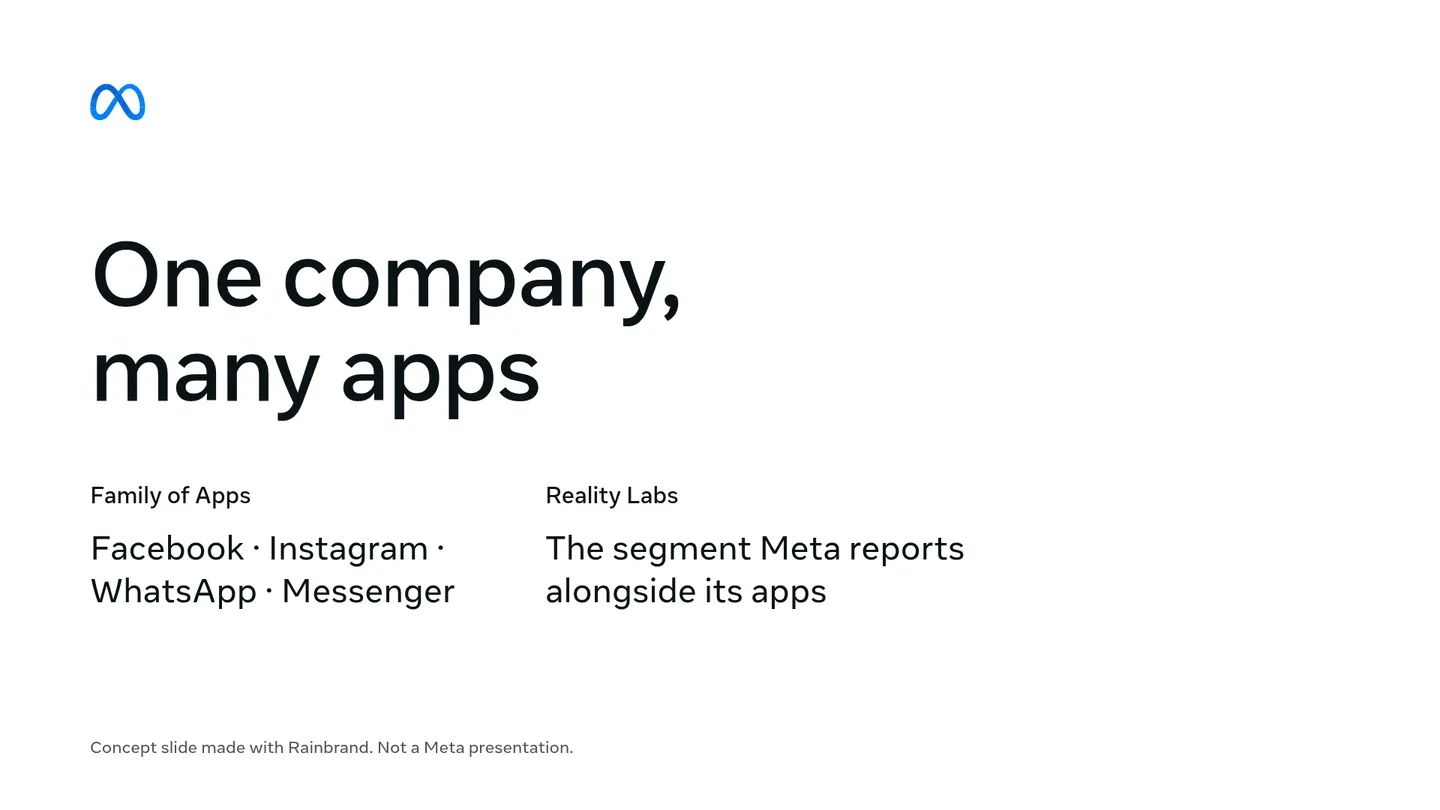
Concept onboarding slide, round one: the logo file's wordmark is white, so only the symbol shows.
| Round | What the Review found | What we changed |
|---|---|---|
| 1 | Colour failed: the footer was a grey outside Meta's palette. Copy failed: describing Reality Labs as “the segment Meta reports alongside its apps” was reporting jargon, against Meta's guidance to explain features in plain language. | Moved to Meta's deep charcoal ground with all text in white, which fixed the footer and showed the logo's white wordmark. Described Reality Labs as where Meta builds virtual and augmented reality. |
| 2 | Logo failed: the blue symbol had dark seams the official artwork doesn't have. Copy passed. | The seams came from the browser drawing the logo's gradients. We rasterised the SVG at high resolution instead. |
| 3 | Logo, typography and copy passed; colour stayed uncertain. | Nothing. |
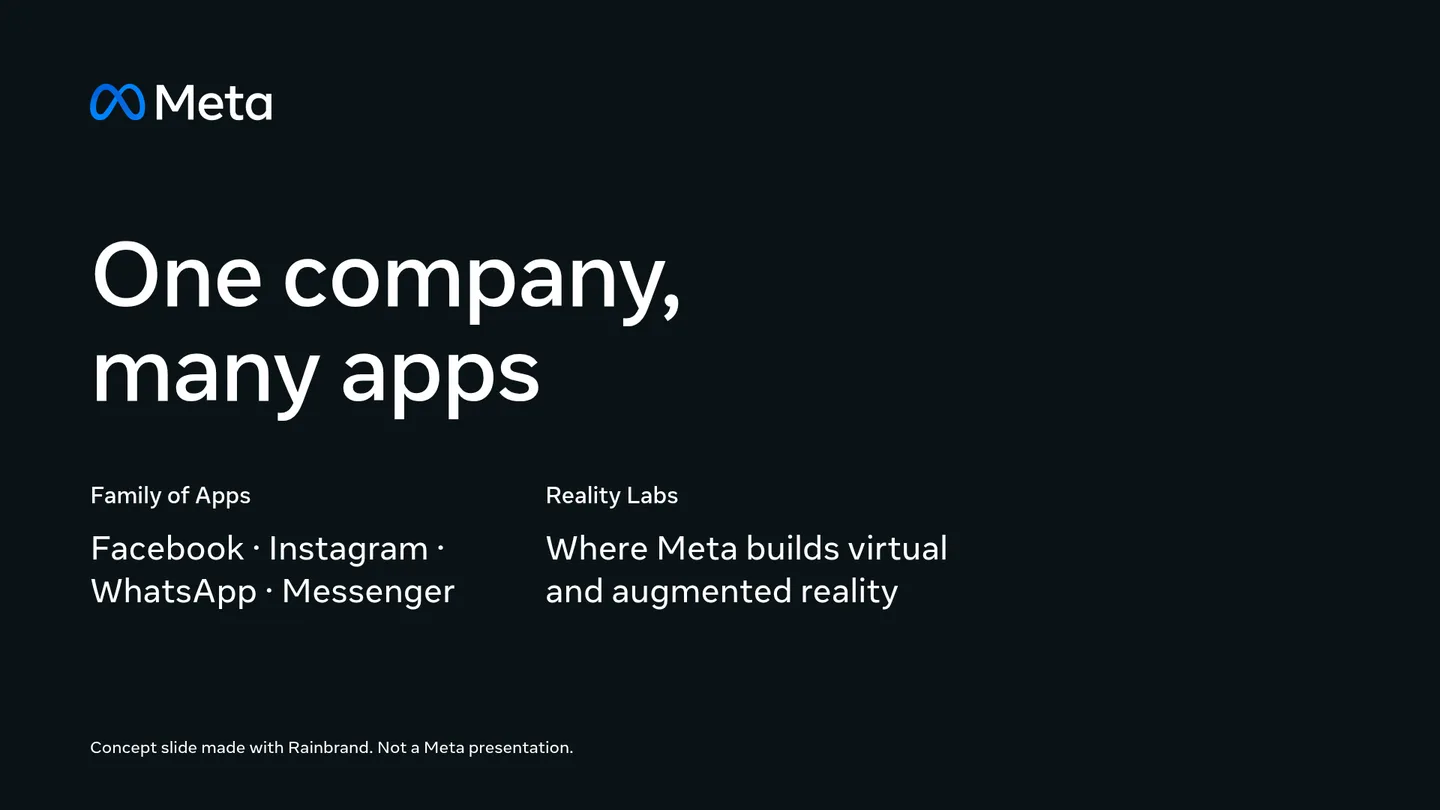
Concept onboarding slide. Round three: logo, typography and copy passed; colour remained uncertain.
One problem got past the Review. The logo SVG the Brief returned, which it described as the primary lockup, has a white wordmark meant for dark backgrounds. On the white slide in round one only the blue symbol showed, and the Review passed the logo anyway. We noticed it by looking at the slide, and the dark ground fixed it.
For a brand team, the run shows three things. The architecture rule reached the task without anyone repeating it. The missing app-mark rule surfaced before anyone guessed at one. And checks catch problems a person might miss, while a person still catches some a check misses.
If app marks belong on slides like this, the next job is to write that rule: which marks, in what order, at what size. In Rainbrand you describe the change, inspect the brand edit it prepares and apply it, and the next deck's agent requests a fresh Brief. Briefs already saved and Skills already exported keep the old guidance, and so do slides already made; updating guidelines across AI tools covers finding those copies.
Where to start
Start with where your brand decisions live today, and which of them your agents can actually reach. You can ask an agent to do the first pass:
List where our brand decisions are recorded: guidelines, decks, folders, Slack threads, design files and saved AI instructions. For each, note what it decides (logo use, colour, type, voice, claims, product names, which brand appears where), when it was last changed and who owns it. Then mark which of these an agent making our next social post, sales deck or product email could reach without help. Quote the source for every finding and list decisions that appear in two places with different answers.Then work through one recurring asset:
- Pick an asset your team makes every week, such as a social post, a sales slide or a product email.
- Write down the decisions it depends on as rules someone else could apply, with one right and one wrong example each.
- Give agents those rules and the original files for each task, rather than a description of them.
- Check the output before it ships, and turn every repeated correction into a rule change.
- When a decision changes, apply it to the brand, have agents request fresh context and replace the copies saved elsewhere.
To do steps three to five with Rainbrand, create an account, connect your agents through MCP or follow the API quickstart, then add your brand from its website, guidelines and files.
FAQ
Who does brand management in a small company?
Usually the founder, the first marketer or a design lead, alongside their main job. The jobs are the same as in a large company, so write down the few decisions that matter most (logo use, colours, type, voice and claims) before more people and agents start making assets.
Can AI agents follow brand guidelines?
Mostly, when each task gives them the relevant rules and the real files, and when what they make is checked. They tend to drift when handed a long PDF in a chat, or adjectives instead of rules. This test shows how to find out whether yours do.
What is the difference between brand management and brand governance?
Brand governance is the part of brand management that decides who may set, change and approve brand rules, and how exceptions are handled. Its counterpart for all published content, not just the brand, is content governance. Brand management also covers strategy, identity, measurement and the daily work of getting decisions into assets. Brand governance for AI agents covers owners, approvals and guardrails when agents make the assets.
More in Brand guidelines
All 18 Brand guidelines articles18 min read
Brand guidelines examples: 12 real brand books and what to copy from each
Twelve brand guidelines you can open today, from Mastercard’s logo rules to NASA’s 1976 standards manual, with the exact rule worth copying from each, which ones an AI agent can read, and what it took to correct an agent’s version of Starbucks.
10 min read
Branding kit checklist: what to include, file formats and real examples
What a branding kit should contain, from logo files and colour values to fonts, templates and rights; what to agree with your designer; what real companies’ kits hold; and a bounded web sample kit, with its index, a template and an asset made from it.
11 min read
Logo usage guidelines: what to include and how to write them
Logo usage guidelines say which logo goes where, how much space it needs, how small it can go, which colours and backgrounds it allows and what never to do. See how Amazon and Strava write each rule, how AI tools get logos wrong, and a template to download.