How to test whether an AI agent follows your brand guidelines
Turn brand rules into a small set of repeatable tasks and checks. Test what the agent retrieves as well as what it makes, then keep the failures that teach you something.
TL;DR
Test real tasks against specific brand rules. Inspect what the agent retrieved as well as what it made, use exact checks for exact requirements and a rubric for judgment, and keep uncertainty visible. Repeat the same cases after changes to the brand, prompt, model or tools.
Decide what the test should prove
Test three questions separately:
- Did the agent retrieve the intended brand’s current guidance and assets?
- Did it apply them correctly?
- Did it flag missing facts or conflicts?
A wrong name may come from an old guide, a retrieval failure or ignored instructions. An overall “brand score” cannot tell you which to fix.
OpenAI recommends real tasks, repeated evaluation and checking automated scores against people’s judgments. Anthropic starts with specific, measurable criteria.
Build a small set of real jobs
Choose cases for the requirements they exercise:
| Case | Rule to test | Evidence |
|---|---|---|
| Launch email | Names, voice, call to action | Draft and claim sources |
| Website hero | Palette and approved UI | Rendered page and references |
| Social image | Logo and exact copy | Final image at publication size |
| New format | Applying the same guidance elsewhere | Output beside the rules |
| Missing fact | Ask or leave the fact unresolved instead of inventing | Question or unresolved item |
| Conflicting request | Explain the conflict and propose a compliant alternative | Explanation tied to the rule and an alternative |
| Superseded tagline | Current guidance | Retrieved context and final words |
Retain failures from real work and keep some cases out of daily prompt refinement.
Keep unchanged work too. Codex used guidance and files from Rainbrand to make a cotton guide and care insert for Son of a Tailor, a clothing brand. The care-insert front was reviewed twice without artwork changes; copy, logo, colour and typography remained passes.
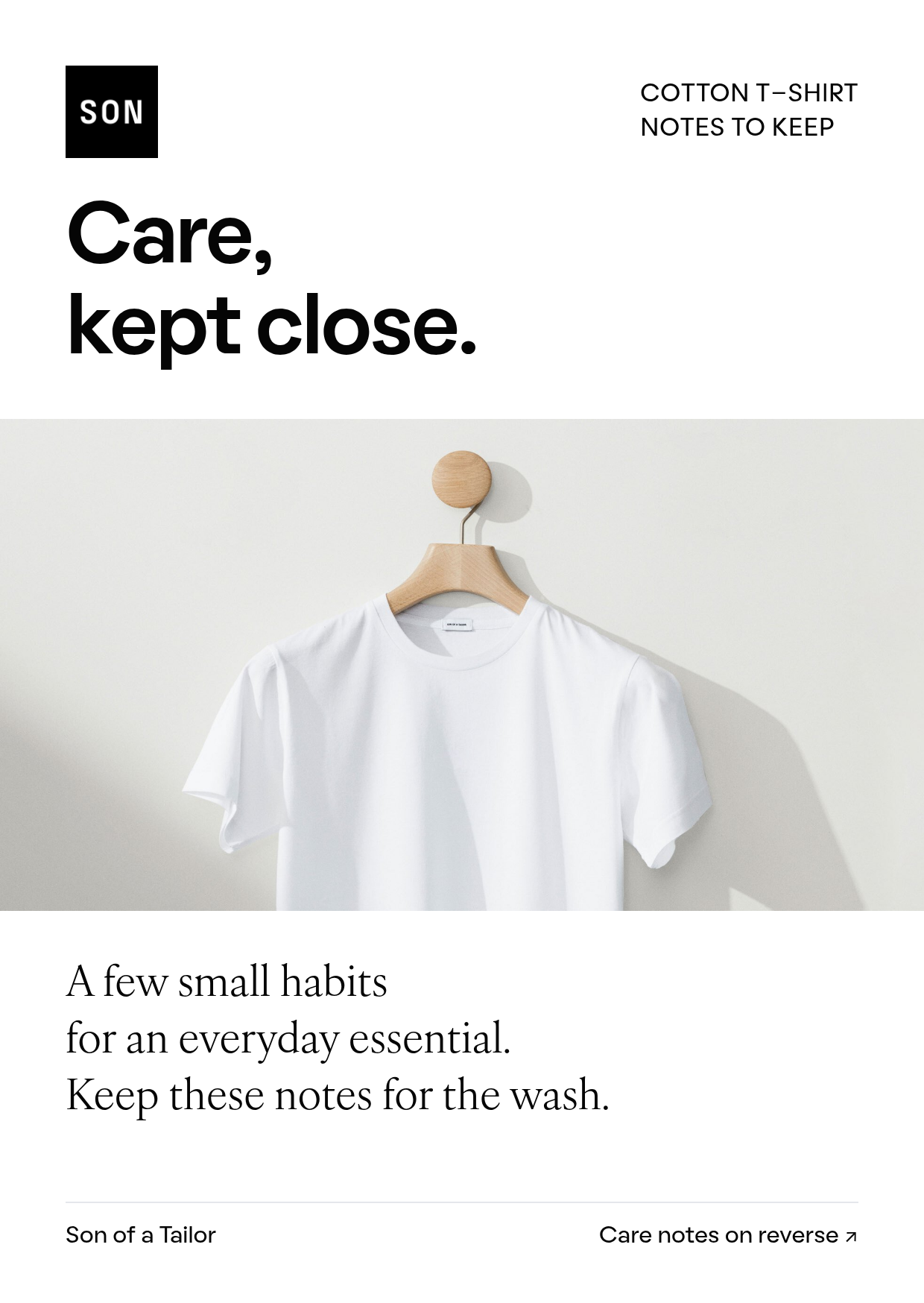
The saved example tests repeated assessment of that piece. Keep unchanged outputs separate from repairs so a changed verdict is not mistaken for a changed design.
Write checks before looking at outputs
Define an observation another reviewer could repeat:
| Vague instruction | Checkable requirement |
|---|---|
| Sound confident | Open with what the reader can do; add no unsupported superlative |
| Show the product correctly | Use the approved screenshot without invented features |
| Use our colours | Match the permitted values and their roles |
| Use new messaging | Include the current name and exclude the retired tagline |
Separate release-blocking rules from preferences. Allow uncertain for insufficient evidence and not applicable for an absent element; first decide whether the task required that element.
Keep the comparison fair
- Decide whether you are comparing models or whole workflows. An old attachment versus a maintained brand tests the setup too.
- Retain the task, context, model where known, settings, tool results and output.
- Use fresh conversations for first-task behaviour; deliberately include history when testing long-running work.
- Repeat important cases under the same policy and retain failures.
- Change one factor at a time when diagnosing a miss.
Inspect what the agent retrieved
A Rainbrand Brief supplies relevant guidance and assets for a task. Save it with the output.
If a tagline is wrong, check whether the current wording reached the agent. Fix the source or retrieval when context is wrong; investigate instruction-following when it was right.
After applying a brand edit, request a fresh Brief to test current guidance. To compare models following identical instructions, give both the same saved guidance. Do not quietly substitute an easier test-only brand.
Use the right reviewer for each rule
| Requirement | Method |
|---|---|
| Exact wording or code value | String or value comparison |
| Voice | Rubric and approved examples |
| Visual identity | Image inspection, measurable references and Rainbrand Review findings |
Where practical, hide which model made each output. Ask reviewers for evidence; inspect disagreements before changing the rule or accepting a verdict. Compare a model grader with people on known successes and failures, and keep task facts and requirements alongside the findings.
Record failures you can fix
Keep a result per rule and task:
Task: [the actual deliverable]
Context used: [saved guidance or Brief reference]
Candidate: [workflow and model, when known]
Check: No unsupported product claims
Verdict: [pass / fail / uncertain / not applicable]
Evidence: [quote or location in the output]
Cause to investigate: [context / retrieval / generation / review]
Next change: [one proposed correction]
Report applicable failures, release blockers and uncertainty. A pattern such as correct names but repeated logo-placement failures suggests a concrete production fix; an average hides it.
Rerun when the work changes
Repeat affected cases after brand, model, connection or workflow changes. Keep repaired failures in the set and add cases from new mistakes.
Start with your team’s last three brand corrections: make each a check and run it on the next draft.
More in Review
All 5 Review articles4 min read
What is brand compliance, and how do you check AI-made work?
Check AI-made work against your brand’s rules. Write rules reviewers can apply, divide automated checks from human judgment, and track what keeps failing.
4 min read
How to make brand governance work for AI agents
Brand governance was built for people who read the guide and ask before they guess. Agents only know what each run gives them. How to turn a governance policy into owners, one approved source, rules, controls and approvals that agents meet while they work.
4 min read
How to check AI images against your brand guidelines
An AI image can look right and still carry a redrawn logo, a near-miss colour or a misspelt headline. What to check, how to turn each guideline into a pass or fail, and where software can do the checking.