
By Siddharth Borderwala
Published
15 min read
How to run brand compliance monitoring across partners and channels
Brand compliance monitoring checks your brand after it ships, on your own channels and in the assets partners, resellers, franchisees and affiliates publish. What to sample and when, how to check what you capture, how to escalate and what to measure, with a monitoring log to copy.
TL;DR
Brand compliance monitoring checks your brand after it ships: on your own channels and in the assets partners, resellers, franchisees, affiliates and marketplaces publish. List where the brand appears, give each party the rules and current files that apply to them, sample their assets on a schedule and after every brand change, check what you capture, and escalate in steps until each problem is fixed.
A company that sells through other people sees its brand in places nobody on its team approved: a reseller’s product page, a franchisee’s window poster, an affiliate’s comparison table, a partner’s footer that still carries the logo you replaced two years ago. Checking assets before they ship is a separate job. Monitoring starts where it ends, with what is already live and what other people made.
Some argue the effort belongs almost entirely before publication. Simple, which sells brand compliance software, calls monitoring “detection after publication” and makes the case that preventing breaches costs less than finding them. For assets your own teams make, that’s right. Partners’ assets are usually made outside your process. You can ask to approve some of them first, as the FTC suggests for paid influencer posts, but monitoring is still how you find what was never submitted and what changed after approval.
What monitoring covers
Three different jobs get called brand monitoring, and they need different tools:
| Job | What it looks for | How it’s usually done |
|---|---|---|
| Compliance monitoring | Permitted uses of your brand that break your rules: old logos, wrong names, missing legal lines | Sampling partner and channel assets and checking them against your rules |
| Brand protection | Uses you never permitted: counterfeits, impersonation, lookalike domains, infringing ads | Marketplace and ad-platform reporting tools, legal notices |
| Social listening | What people say about the brand | Listening and media-monitoring platforms |
This guide covers the first. The edges blur: a reseller bidding on your name with a misleading ad is a partner breaking your rules and possibly an infringement too.
Why partners’ use is your problem
US regulators and trademark law both put monitoring inside the brand owner’s job, not just the partner’s. Your own counsel should tell you how they apply to you; the point here is that the expectation exists.
The Federal Trade Commission’s Endorsement Guides FAQ says advertisers “need to have reasonable programs in place to train and monitor members of their network”, and lists four elements: tell them what they can and can’t say about the product, tell them how to disclose their connection to you, “periodically search for what members of your network are saying”, and act on what you find. The scope depends on the risk; the FTC’s own example is that a network selling health products needs more supervision than one promoting a fashion line. Endorsers under contract should be monitored for the contract’s length and “a reasonable time, such as a few months” after it ends. Handing the program to a PR firm doesn’t move the responsibility: the FTC says to ask for regular reports and check the network yourself.
Trademark law adds a quieter reason. The Lanham Act defines a related company as one “whose use of a mark is controlled by the owner of the mark with respect to the nature and quality of the goods or services”, and lets that controlled use count for the owner. Its definitions also treat a mark as abandoned when the owner’s conduct, “including acts of omission”, makes it lose its significance as a mark. So when dealers, franchisees and partners use your marks under licence, checking how they use them is part of showing that you control them.
There’s also a practical reason: when your brand changes, partners don’t change with it unless someone checks.
Map where the brand appears
Start with an inventory. For each place your brand appears outside your direct control, note what to check there and what you can actually do about a problem, because the lever decides how you escalate.
| Where it appears | What to check | What gets it fixed |
|---|---|---|
| Your own site, emails and social accounts | Logo version, product names, claims, legal lines, expired offers | Your team |
| Resellers, retailers and marketplace listings | Product names, photos, descriptions, logo use, prices | The reseller agreement; marketplace brand tools |
| Dealers and franchisees: local sites, ads, signage | Logo version, required disclaimers, offers, local claims | The dealer or franchise agreement, and any local ad funding |
| Affiliates and influencers | Claims, disclosures, use of your name and logo | Program terms; removal from the program |
| Other advertisers’ search ads | Your name in ad text, whether a reseller is clear about what it is | A trademark complaint to the ad platform |
| Partner, integration and co-branded pages | Lockups, logo version, wording that implies endorsement | The partnership agreement |
| Agencies working in your name | Everything above | The contract, and regular reports |
Two platform tools are worth knowing. Google Ads lets resellers use a trademark in ads when the landing page sells the product and makes clear it’s a reseller, and takes trademark complaints against specific advertisers identified by URL. Amazon Brand Registry gives enrolled brands tools to report suspected infringement and protect their listing information.
Write the rules partners follow
Your brand guidelines are written for your own team. Partners need a shorter set: the files they may use, what they may claim, and what needs your approval. Publish it, give them the current files, and you have something to check against.
Trustpilot is a good model because so many other companies display its brand. Businesses that use the review platform show its logo, star ratings and TrustScore on their own sites and in their ads, and its Legal Brand Guidelines (version 2.0, February 2023) tell them how:
- Use the official files. Use the widgets and assets in your Trustpilot account, follow the Brand Hub’s style guidance such as the safe space around the logo, and don’t alter the brand.
- Keep claims checkable. Put the word “TrustScore” next to the number, show the logo whenever you show a rating, link back to your profile, and add a date stamp or review count in offline marketing and advertising. Ranking claims must follow set wordings, such as “Ranked #1 in [category name] based on [xxx] reviews on Trustpilot”.
- Don’t imply what isn’t true. Don’t suggest Trustpilot endorses you, compare your score with other businesses’, or use Trustpilot in your company or product name.
- Ask first for some channels. Out-of-home advertising, including print, billboards, buses and posters, needs Trustpilot’s approval.
The guidelines also name misuse directly: a static image of your TrustScore or star rating on your website, a score for one domain shown on another, and widgets outside your plan. That list doubles as a monitoring checklist. Several of its items are about data, not design: whether the score is current, whether the widget is live. A visual check alone can’t settle those.
What to sample, and when
Run two kinds of sweep.
Event sweeps follow a change: a brand refresh or new logo, a positioning change, a new campaign, a changed price or offer, a new partner, or the end of a partnership. These look for stale assets, and they’re small because you know what changed.
Rolling samples catch everything else, and they’re what lets you make a claim about the whole network. Before you draw one, decide what you’re estimating, because the unit of the sample has to match the unit of the claim:
- Placements. If the question is what share of live placements break a rule, the population is every placement in your inventory on the day you draw, and the unit is one placement: a page, a listing, an ad, a sign. Draw placements at random, so each has the same chance of being picked.
- Partners. If the question is what share of partners show a problem anywhere, the unit is a partner. Draw partners at random, inspect all their placements, and decide before you look how to classify a partner, for example as failing if any placement fails. If you inspect only a fixed number of each partner’s placements, the result is the share with a problem in the placements you inspected, which can understate the share with a problem anywhere.
The two answers differ. Partners have different numbers of placements, and one partner’s template can repeat the same problem across dozens of pages, so a placement sample says nothing direct about the share of partners.
Here is one worked calculation, with example numbers. The inventory lists 1,200 live placements across 85 partners. In March you draw 40 placements at random. Three show the retired logo. One comes back uncertain, and a person checks it and confirms it passes. The other 36 pass. The estimate is 3 in 40, or 7.5% of placements, and the exact 95% confidence interval for 3 in 40 runs from about 1.6% to 20%. So the claim you can make is that somewhere between 2% and 20% of placements showed the retired logo in March. The three failures came from two partners, which tells you about those two, not about the share of partners.
The size of the sample decides what a clean result means. If you check n randomly chosen placements and find nothing wrong, the most you can say with 95% confidence is that the true failure rate is below 1 − 0.05^(1/n), which is close to 3/n. Statisticians call this the rule of three.
| Placements checked at random, none failing | Placement failure rate you can rule out (95% confidence) |
|---|---|
| 10 | Above about 26% |
| 30 | Above about 10% |
| 60 | Above about 5% |
| 100 | Above about 3% |
So a clean check of ten placements says little. Thirty is a reasonable minimum for a claim like “fewer than one in ten of our placements show an old logo”.
Check the riskiest placements as well, on top of the random sample: regulated claims, high-traffic partners and new partners. Log those checks with how they were selected and report them separately. They tell you about those partners, and because you chose them for their risk, they can’t stand in for the network as a whole.
Capture each sample as a reader would see it: the whole asset, at a size where the type is legible, with the URL or location, the date and time, and who captured it. Keep the capture. Pages change, and the finding has to point at what was there.
Check what you capture
Once you have a capture, compare it with the rules that apply to whoever made it. You can do that by eye against a checklist, or with an automated check. A Rainbrand Review is one: Rainbrand keeps a brand’s identity, guidance and files as shared context that agents can call, and a Review checks an image of an asset against that brand’s colour, typography, logo and copy rules. It returns a verdict for each check, with a reason and, where available, evidence pictures.
Here is what one returns, using an asset from one of our published examples rather than a partner’s page. Yumbun sells bao from counters in two London food halls. Claude made a 20-second menu loop for the screens above those counters, and Reviews checked frames from it. On the end card, the four checks came back three different ways:

The end card as first checked.
- Copy passed. The tagline and prices matched what was expected.
- Colour passed. The cream background and black lettering matched the palette, and the Review noted that the yellow flower came from the supplied menu graphics.
- Logo failed. The Review said the smiley had been redrawn rather than taken from the original artwork. It was in fact a decorative smiley from Yumbun’s website, not its brand icon. The Review also called the wordmark stretched; Claude measured it at 1.508:1 against the source file’s 1.505:1 and left it.
- Typography came back uncertain. The headline matched the brand’s bold font, but the price sits in a tilting flower, so its font couldn’t be confirmed.
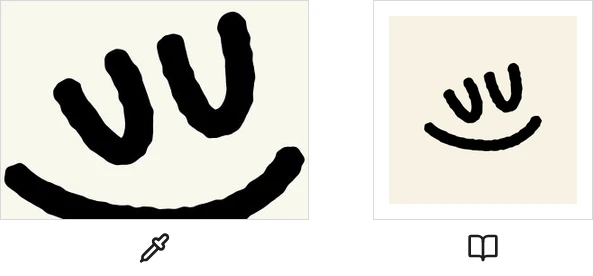
The logo check’s evidence: the end card’s smiley, left, and the brand’s icon, right.
Review doesn’t edit the asset. Claude swapped in the brand icon itself, and the logo passed on the next check, while typography stayed uncertain on both rounds. The full Yumbun example keeps every round.
Reading results like these, three habits help when you monitor:
- Read the reason, not just the verdict. Half of that logo finding was right and half wasn’t, and only a measurement settled it. Check measurable claims yourself before you send a partner a fix request.
- Send uncertain results to a person. Don’t count them as passes or as failures.
- Choose checks that match what the partner owes you. A partner’s page set in its own font can fail a typography check against your brand without breaking any rule you gave it. Pick the checks that cover your partner rules, and put those rules and the exact expected text in the notes you send with the image.
A visual check also can’t settle data. Two items on Trustpilot’s misuse list, an out-of-date score and a static image where a live widget belongs, look the same in a screenshot as the real thing. Check those against the live source and the page itself, as separate steps.
That’s the right place for Review in monitoring: the check you run on an asset you’ve already found and captured. Rainbrand doesn’t crawl the web or watch partners’ sites; your sweep, or a tool built to crawl, finds the placements. Bynder offers AI agents that scan the public web for where your assets are used. PerformLine monitors partners and reps across the web, calls, email and social for regulated industries. The Search Monitor watches paid search and affiliate landing pages. For tools that check assets before they ship, see the brand compliance software comparison.
Escalate in steps
The first message should explain rather than threaten: many findings turn out to be an old file or a rule nobody sent. Trustpilot’s Action We Take policy publishes one such ladder:
- An educational email explaining what was found and how to avoid it.
- A warning asking the business to stop.
- A cease-and-desist notice, the last step before stronger action.
- Account restrictions.
- A public Consumer Warning on the business’s profile, which hides its TrustScore, usually for about six months.
- Legal action, or sharing information with regulators or law enforcement.
Serious cases can skip straight to a later step. For scale: in 2024, across all kinds of platform misuse rather than brand misuse alone, Trustpilot’s Trust Report counts about 17,000 educational notifications, 19,000 warnings and 5,000 cease-and-desist letters.
Your ladder will use your own levers: the partner agreement, program terms, local ad funding, a listing on your site, a platform complaint. Match the starting step and the deadline to severity:
| Severity | Examples | Response |
|---|---|---|
| Critical | False or unapproved claims, missing required disclosures, implied endorsement | Same day; ask for removal, then fix |
| Major | Old logo or retired name, wrong product details, outdated price or score | A fix within a set window, usually days |
| Minor | Spacing, a near-miss colour, an approved but dated photo | Batch with the partner’s next update |
When the same finding turns up at several partners, stop sending individual fix requests. The cause is upstream: an old file in the partner kit, a template nobody updated, a rule nobody sent. Fix the source and tell everyone at once. If the brand change came from your own guidelines, update them once before re-sending files, and retire the old files where your own teams and agents pick them up, as the retirement stage of a content production workflow describes.
Who owns what
Split the work by what each person can actually change. The brand team owns the partner rules and the approved files. Partner, channel or franchise managers own the relationship, so they send fix requests and chase them. Legal owns claims, disclosures and trademark escalation. Someone in brand or marketing operations runs the sweeps and keeps the log. If an agency runs your affiliate or influencer program, it can run sweeps too, but the FTC’s point stands: ask for its reports and check some placements yourself. Brand governance for AI agents covers how to set owners for rules more generally, and content governance does the same for everything you publish.
A monitoring log to copy
Keep one row per inspection, not per finding: clean results and uncertain ones too, each with its capture attached. A log of findings alone can’t tell you how much you checked or what share failed, because the passes are missing.
Inspection ID:
Partner:
Placement:     URL or location
Selected by:   Random draw, event sweep, risk
               check or outside report
Captured:      Date, time, width, by whom
Rules applied: Partner rules, brand version
Raw results:   Pass, fail or uncertain, per check
Confirmed:     Pass, fail or can't tell, and who
               settled it
Data checks:   Live score, price, link
Severity:      Critical, major or minor
Action, date:  Note, warning, contract step
Owner:         Who chases it
Fixed on:      Date, with a new capture
Cause:         Partner error, old kit file,
               missing rule, our own change
Automated results count only once someone has confirmed them; the uncertain end card above would sit in the log as uncertain until a person settles it. In the March example, the log holds 40 rows selected by random draw: three confirmed fails, 37 confirmed passes including the one a person settled.
Measuring it
The number of problems found says little on its own; a bigger sweep finds more. Each of these comes straight from the log:
| Measure | Calculated from the log |
|---|---|
| Coverage | Distinct placements inspected in the period, divided by distinct placements in the inventory |
| Placement failure rate | Confirmed fails divided by inspections, random-draw rows only |
| Stale assets after a change | Confirmed old-version fails divided by inspections, event-sweep rows only |
| Time to fix, by severity | Fixed on minus the action date |
| Repeat findings by partner | Confirmed fails grouped by partner across periods |
| Found by you vs reported | Outside-report rows compared with sweep rows |
The cause field matters most. If most failing rows say “old kit file”, update the kit and send it to every partner at once.
FAQ
What is online brand compliance?
It usually means monitoring applied to digital channels: websites, marketplace listings, social accounts, search ads and affiliate pages that show your brand. Because those pages change without notice, the captures you keep are the only record of what was live when you looked.
Should you approve partner assets before they go live instead?
Where you can, yes; the FTC notes that reviewing posts before they’re published is easier than searching for them afterwards. Approval covers what partners submit. Monitoring still finds what they never submitted and what they changed later, so use approval where you can and monitoring for the rest.
More in Review
All 9 Review articles11 min read
AI governance for marketing: permissions, approvals and brand checks for agents
What marketing agents may read, draft, change and publish in your CMS, ad accounts, email platform and CRM, which assets need whose approval, what to record and disclose, and where brand checks fit. With a proposed one-page policy for one workflow, and a run that shows a stale brand edit being refused.
8 min read
What is brand intelligence? The monitoring meaning and the production meaning
Brand intelligence usually means data about how a brand is seen and discussed: listening, sentiment, share of voice, reviews and now AI answers. Vendors also use it for applying and checking brand knowledge while assets are made. What each meaning covers, the kinds of tools, and which one you need.
12 min read
What is content governance? A framework, a plan template and the AI version
Content governance decides who creates, approves, publishes, maintains and retires content, and by what standards. A six-part framework, the NHS website's approval chain as a worked example, a plan template to copy, and what changes when AI agents draft and publish.