By Siddharth Borderwala
Published
9 min read
Why is brand consistency important when AI makes your assets?
The evidence for brand consistency, traced to its sources. Where the popular 23%, 33% and 10–20% revenue figures really come from, what research on distinctive brand assets shows, what changes when AI tools make many of a brand’s assets, and how to measure consistency.
TL;DR
Brand consistency matters because buyers notice and remember brands through a few distinctive assets, such as a logo, a character or a typeface, and those only work if they appear the same way every time. The popular revenue figures are survey estimates and attributions, not measurements. When AI makes many of your assets, keep the distinctive assets fixed, let the rest vary, and measure both.
Most pages that answer this question lean on a revenue number: consistent branding increases revenue by 23%, or up to 33%, or 10 to 20%. Those figures are real, but they come from different surveys asking different questions, and none of them measured revenue. It’s worth knowing which is which before you put one in a budget request, because the better reasons for consistency are better evidenced and say more about what to keep consistent.
Where the revenue figures come from
All of them trace to Lucidpress, which sold brand templating software and is now called Marq. It surveyed marketers about brand consistency in 2016, 2019 and 2021, with two relevant publications in 2021, and the questions differ in a way that matters: asking what you would gain is a hypothetical estimate; asking what consistency has contributed is respondents’ own attribution after the fact. Neither is a measurement of revenue against a comparison group.
| Edition and sample | What respondents were asked | Figure and type |
|---|---|---|
| 2016, with Demand Metric; sample size not given in the release | At organizations with consistency problems, the revenue increase they would attribute to always presenting the brand consistently | 23% on average; a hypothetical estimate |
| 2019, more than 200 organizations | The revenue growth they would expect if the brand were consistently maintained | 33% on average; a hypothetical estimate |
| 2021 State of Brand Consistency, more than 450 respondents | How much revenue would increase if the brand were consistent | 10–20%; a hypothetical estimate |
| 2021 Content Effectiveness Report, 452 professionals | How much of their revenue growth brand consistency has contributed | 68% said 10–20% or more; retrospective attribution |
So the 10–20% on many pages is not a garbled 23%; it’s the 2021 edition’s answer to a similar question. The problems come in the retelling. Lucidpress’s own 2019 headline turned an average expectation into consistent branding that “can see up to 33% increase in revenue”. BrandLife credits “Marq’s 2019 State of Brand Consistency report” with revenue increases “of up to 23%”, the 2016 estimate under the 2019 name. Frontify says a Marq report found consistency “can increase profitability by more than 20%”, though none of these editions asked about profit. Beautiful.ai reports the 2021 range correctly but as something consistency “can” do, which turns an estimate into a finding.
The surveys do support narrower claims worth keeping. In 2016, 71% of respondents said inconsistent branding causes confusion in the market; in 2019, 81% said their organization deals with off-brand content; in 2021, 77% did. That’s evidence that marketers believe consistency pays and struggle to achieve it. It isn’t evidence of how much it pays.
What the evidence shows
Better evidence comes from research on how buyers remember brands, most of it from the Ehrenberg-Bass Institute at the University of South Australia.
Byron Sharp and Jenni Romaniuk define brand salience as “the propensity of the brand to be noticed or come to mind in buying situations”. Buyers don’t study brands. They notice them in passing, on a shelf or a feed, and the things that let a brand be noticed without reading its name are its distinctive assets: a logo, a colour, a character, a typeface, a jingle.
Romaniuk sets two tests for a distinctive asset in Brands of Distinction: it must be unique, bringing only your brand to mind, and famous, so that everyone who sees it thinks of your brand, and “of these two, uniqueness is most important”. An asset only gets there through repetition in the same form. In her words: “Inconsistencies in colours, fonts, logos and the like are the enemy of distinctive asset building.”
Not every brand element can become yours, however consistently you use it:
- Ward, Yang, Romaniuk and Beal (2020) tested 1,281 in-market brand elements across 13 consumer packaged goods categories in 19 countries. Characters, logos and logotypes had the greatest potential for unique ownership. Colour was “more challenging to develop as a unique brand identifier due to high levels of competitive sharing”.
- Fiocchi and Esfahani (2024) repeated the method for UK car brands. Logos were the most uniquely ownable type; fonts, slogans and colours were not, and 33 of the 44 assets tested reached only low uniqueness.
Consistency over time shows up in advertising effectiveness data too. System1, which sells ad testing, analysed the IPA’s database of effectiveness case studies and reported that campaigns built on a recurring character or scenario were more often associated with long-term profit and market share gains than campaigns without one. That’s an association across case studies, not proof that the device caused the gains. It estimated that such a device is worth the equivalent of 12 extra points of share of voice, and found that only 7% of UK TV advertisers used one. Those are a vendor’s estimates from its own analysis, but they point the same way as the memory research.
Put together: consistency works through memory, and it does most for the assets that can become uniquely yours. Using a common blue the same way every time does far less than using your own logo or character the same way every time.
Consistent isn’t identical
Consistency is about the assets, not the layouts. Gut Oggau, a biodynamic winery in Austria’s Burgenland, gives each of its wines a face and a name, as members of one family across three generations. In October 2026, Claude made three pieces from those faces and the descriptions on gutoggau.com: a two-sided paper runner for the long tables at its wine tavern, a three-bottle gift box and a 20-second vertical film in which the faces draw themselves. It worked from Gut Oggau’s guidance and files in Rainbrand, which keeps a brand’s context for agents to call.
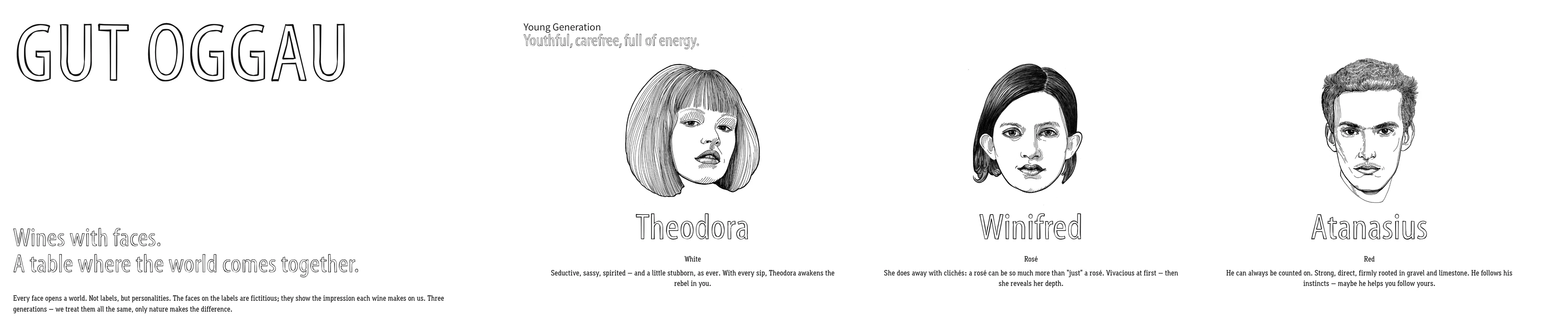
Table runner, English side

Gift box

Film, last frame
The format, size, language and layout change in each. The faces, their names, the outlined lettering and the black-on-white drawing style don’t. Those are the parts a buyer would recognize from across a room, and they’re character and logotype assets, the types Ward and colleagues found easiest to own.
A practical split for any brand, the line a visual identity system draws for its visual parts:
| Keep fixed | Let vary |
|---|---|
| Logo artwork, characters and other distinctive assets | Layout, crop and format |
| The colours and type that are distinctive to you, used as specified | Imagery, scenes and illustration within the style |
| Product names, facts and claims you can support | Headlines and campaign ideas, within voice rules |
| Voice rules that shape every message | Language, length and channel conventions |
A guide that fixes everything leaves no room for a new campaign; one that fixes nothing gives buyers nothing to remember. Decide which assets carry recognition, and protect those; published brand guidelines show how other brands write those rules.
What changes when AI makes the assets
Three things change when agents and generation tools make many of a brand’s assets.
Volume turns rare mistakes into many. One logo error in a hundred variants is a nuisance at ten variants and a hundred wrong logos at ten thousand. Checks that sampled a few assets a week no longer cover the output.
AI-made assets can drift on the very details that make an asset distinctive. Extropic builds hardware for thermodynamic computing, and its logo is a diamond with four stippled wings. When Claude made a 20-second film about Extropic’s Z1 chip, the end card drew the mark at 150 pixels and its outer dots disappeared. A Rainbrand Review, a check of a finished asset against the brand, failed the logo. Claude redrew the mark at the file’s own 256 pixels and it passed.

Before: the mark at 150 pixels; the logo check failed.

After: the mark at 256 pixels; the logo check passed.
Both crops are the same size, centred on the mark, and enlarged twice without smoothing. The words and type passed in the first version. The part that failed was the part that makes the mark Extropic’s. Not everything resolved: on the final card the colour check came back uncertain, because the thin gold line under the headline was too fine to measure, so a person had to judge it. The full Extropic example keeps both end cards and every round.
Copies of the guide drift apart. Each tool a team uses keeps its own copy of the brand: a system prompt, a project’s instructions, a template, a set of uploaded files. When the brand changes, every copy needs the change, and the ones nobody updates keep producing the old version. The same happens outside the company, in the files partners downloaded once and keep using; brand compliance monitoring covers how to find them.
Keeping one maintained version reduces the copies but doesn’t remove them. In Rainbrand, a change to the brand is a brand edit you inspect and apply, and agents then need a fresh Brief, the guidance and files selected for their task. A Brief saved before the edit, or a Brand Skill exported as a folder, is a snapshot and keeps the old version, and so does every asset already made. Those are the copies to track when the brand changes. The guide to keeping AI-generated content on brand covers the rest of the setup.
How to measure brand consistency
Measure two things separately: whether buyers recognize your assets, and whether your assets use them correctly. A brand can score well on one and badly on the other.
| What to measure | How | What it tells you |
|---|---|---|
| Fame and uniqueness of each asset | Show category buyers the asset without your name and ask which brand it brings to mind; repeat yearly | Which assets carry recognition, and which are shared |
| First-pass rate on brand checks | Share of finished assets that pass logo, colour, type and copy checks on their first review | Whether makers and agents get the brand they need |
| Failures by rule | Group failed checks by the rule they broke | Which rule or file keeps getting lost |
| Stale assets after a change | After a logo, name or claim change, sample live placements and count the old versions | How fast a change reaches every channel and partner |
| Copies of the brand in use | Count the prompts, projects, templates and kits that hold their own copy of the brand | How many places a change has to reach by hand |
The first row measures buyer recognition, the memory effect the research above connects to consistency. None of the rows measures revenue. Romaniuk notes that “surprisingly few managers can identify the distinctive assets of their brands, let alone quantify their strength”. Sharp suggests adding distinctive assets to the brand tracking surveys most companies already run. The other rows tell you whether your execution protects the assets that row shows are working. What brand compliance covers goes deeper on the check measures, and brand compliance monitoring on sampling what’s already live.
FAQ
What is the difference between brand consistency and brand compliance?
Brand consistency is the outcome: the brand looks and sounds recognizably the same everywhere. Brand compliance is the checking that each asset follows the rules that produce it, before and after it ships.
Should a rebrand keep the old distinctive assets?
Keep any that buyers already recognize unless you have a strong reason to drop them. Romaniuk’s advice in Brands of Distinction is to look through the brand’s history for assets worth reviving and to treat a refresh with caution, because change isn’t consumer friendly. Test recognition of the current assets before deciding which to retire.
More in Brand guidelines
All 18 Brand guidelines articles18 min read
Brand guidelines examples: 12 real brand books and what to copy from each
Twelve brand guidelines you can open today, from Mastercard’s logo rules to NASA’s 1976 standards manual, with the exact rule worth copying from each, which ones an AI agent can read, and what it took to correct an agent’s version of Starbucks.
10 min read
Branding kit checklist: what to include, file formats and real examples
What a branding kit should contain, from logo files and colour values to fonts, templates and rights; what to agree with your designer; what real companies’ kits hold; and a bounded web sample kit, with its index, a template and an asset made from it.
11 min read
Logo usage guidelines: what to include and how to write them
Logo usage guidelines say which logo goes where, how much space it needs, how small it can go, which colours and backgrounds it allows and what never to do. See how Amazon and Strava write each rule, how AI tools get logos wrong, and a template to download.