
Rainbrand vs Canto: what can your AI agents get from each?
Canto is a DAM that stores, organises and distributes approved files, with its own AI inside the library and an MCP server for product data. Rainbrand maintains a brand that agents call for each task; here is what each gives an agent today, where each fits and how to move agent work from Canto.
TL;DR
Use Rainbrand for the work your agents make: it maintains your brand, gives each task the guidance and files it needs, and reviews the result. Canto is a digital asset management (DAM) library of approved files; its only documented Model Context Protocol (MCP) server covers Product Hub data, with a DAM server listed as coming soon. Move that work to Rainbrand from the Style Guide and approved files in Canto.
Two jobs around one brand
Canto’s centre is the library: images, video and documents with metadata, approvals, rights and expiry dates, shared through portals and a Style Guide.
Rainbrand builds a brand’s identity, guidance and assets from a website, brand guide, logos or images. Agents call it when they make something new, to get what the task needs and check the result. DAM vs a brand layer for agents covers the general difference.
| Canto | Rainbrand | |
|---|---|---|
| Main job | Store, organise and distribute files | Give agents a maintained brand per task |
| Brand guidelines | Style Guide web pages for people | Guidance an agent gets for each task |
| MCP | Product Hub data now; DAM server “coming soon” | Brands, Briefs, Reviews, edits, library |
| Checking work | Proofing by reviewers in Approval Hub | Review of work against the brand |
| When the brand changes | Agents see it only if someone updates their copies | Apply an edit; the next Brief uses it |
| Pricing | “Get pricing” on every plan; Product Hub in the Retail Suite, Brand Studio and Approval Hub in the Brand Suite | Published plans |
What Canto does well
If people and partners need to find and use approved files correctly, this is the job:
- Finding files: AI Visual Search takes plain-language requests, finds matching clips inside videos and combines that with your metadata.
- Portals and Style Guides: unlimited from the entry plan. A portal shares chosen folders with an expiry date; a Style Guide is a web page built from files marked Approved.
- Templates and approvals: Brand Studio locks logos, fonts and layouts in templates, and Approval Hub runs reviewer markup on PDFs, images and video.
- AI in the library: the Global Assistant, from DAM Plus, finds content, fills metadata and alt text and flags rights gaps; AI Quick Edit, enabled on request for admins, edits images.
- Delivery: Media Publisher serves approved files to websites, with integrations for Adobe, Figma, Canva, Shopify and Amazon.
All of this works on files already in Canto, not on new work an agent makes in another tool.
Can Claude or ChatGPT use Canto?
- Product Hub, live since July 2026: its MCP server searches and updates product records. The setup guide limits it to Product Hub Admins with one API key for the organisation, and warns that changes “cannot currently be undone from within the interface”.
- The DAM, coming soon: the Canto DAM page and Canto AI list a DAM MCP server as coming soon, while the pricing page lists “API and MCP access” from DAM Plus, so ask Canto what that covers today.
- Zapier: Zapier’s Canto MCP uploads files and watches for new ones, but doesn’t search the library.
Searching the asset library or reading a Style Guide from Claude isn’t documented as of October 2026.
What an agent needs to make new work
Say the marketing team asks Claude for three 1080 × 1080 launch ads, and your files live in Canto.
With Canto alone, someone downloads the approved images into the chat and pastes the Style Guide’s colour and type sections into a Claude project. Each project and teammate gets its own copy, and nobody updates them all when the palette changes.
With Rainbrand, Claude requests a Brief for the ads and gets the guidance and selected files, such as the logo and reference images. It makes the images with Rainbrand’s AI Gateway or its own tools, then requests a Review that gives colour, typography, logo and copy a verdict each.
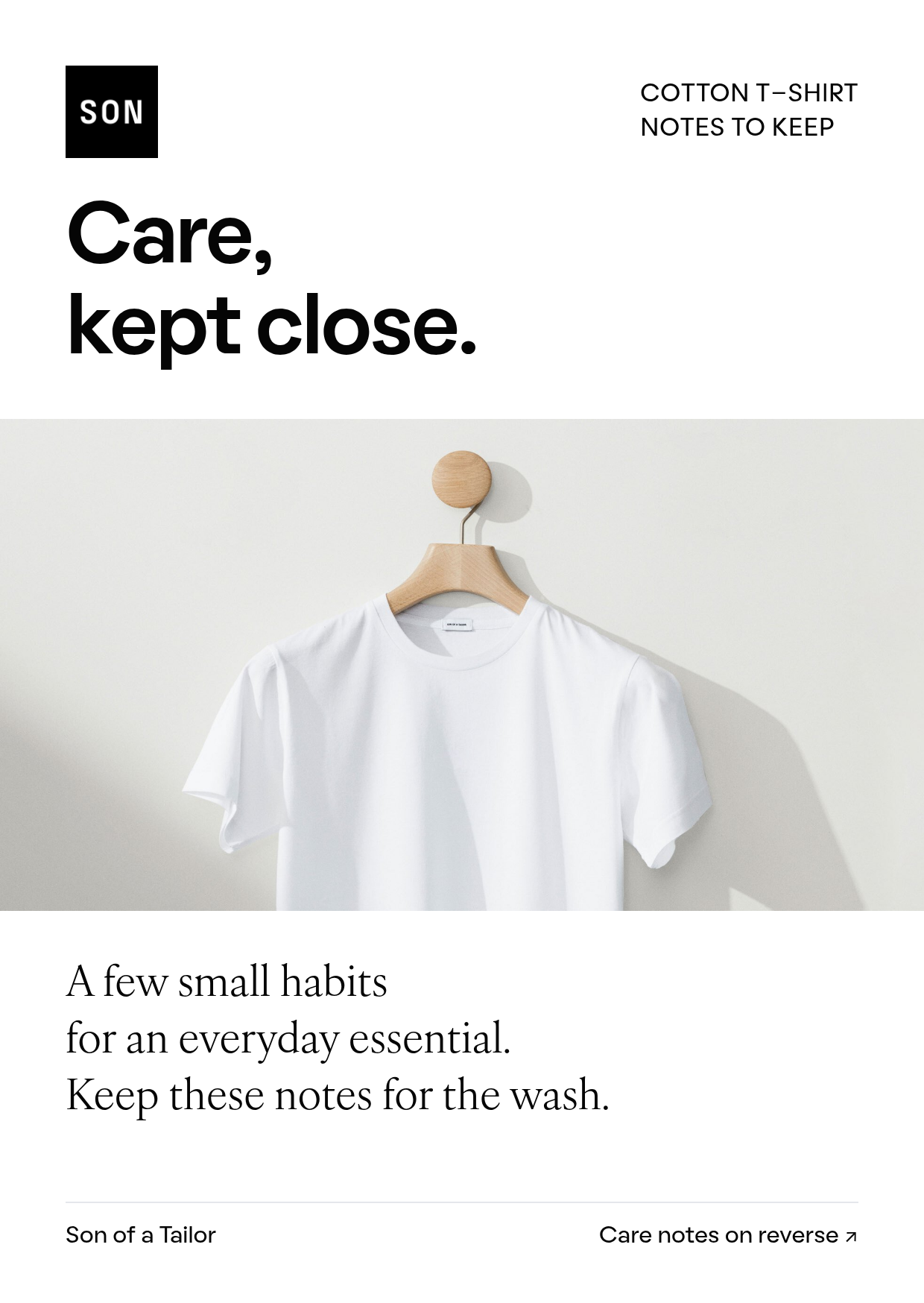
A Brief also says how to use a file. Son of a Tailor makes T-shirts, shirts and knitwear in custom sizes. When Codex made a care insert for its Cotton T-Shirt, the Brief picked the closest library photograph, a white crewneck on a wooden hanger, and noted that the files don’t confirm it shows the current shirt, so the insert shouldn’t imply an exact match. The front of the insert used that photo and passed all four Review checks:

The photo the Brief picked
Front of the finished insert
Building on the API
Canto’s REST API reads and writes a customer’s own library, with OAuth 2.0 and webhooks for asset changes. It has no endpoints for reading what a Style Guide or portal shows, so it suits keeping a CMS or storefront supplied with approved files. Rainbrand’s API adds each customer’s brand from a website, files or an Instagram account, then requests Briefs and Reviews and applies brand edits.
The two can meet in your code: fetch approved files through Canto’s API and pass them to Rainbrand as sources, and let a Canto webhook tell you when to prepare an edit. Canto doesn’t store webhook messages, so its integration guide also recommends a scheduled consistency check. Neither product documents a connector to the other.
Moving agent work from Canto to Rainbrand
- Sign up and connect Rainbrand to your agents.
- Download the approved logos and key images your recurring work uses, or fetch them through Canto’s API. Save the guidance behind your Style Guide as a PDF or document.
- Add the brand from those files, the guidance and your website, and check what Rainbrand builds.
- Point agent work at Rainbrand. Product Hub admins can still connect Product Hub MCP for product facts.
Storage, approvals, rights, portals, product data and delivery don’t move; keep Canto for those if people still use them. While both run, Rainbrand doesn’t sync from Canto, so when the Style Guide changes, describe the change to Rainbrand, and remove retired files from the Brand Library too.
Canto’s DAM has no MCP server yet, so an agent can’t run the same task through it to compare. Ask it to work out the split instead:
Here’s what we use Canto for today: [list the jobs]. Using Canto’s documentation and Rainbrand’s, tell me which of this work should move to Rainbrand, which jobs only Canto can do for us, and which files and guidance I’d need to take out of Canto to add our brand to Rainbrand.Start with your next launch
Once the brand is ready, have your agent make the launch ads from a Brief and compare them with the last set made the current way: the files used, what went wrong and how much you fixed by hand. If you’re building the workflow for customers, use the API.
More in Comparisons
All 11 Comparisons articles5 min read
Rainbrand vs Adobe GenStudio, Firefly and AEM: which keeps AI content on brand?
Adobe splits this job across GenStudio’s brand checks, custom Firefly models and brand rules in AEM, which outside agents can reach over MCP with the right licence. Rainbrand gives any agent or product a maintained brand to call. Here’s which fits, and how to move agent work from Adobe to Rainbrand.
6 min read
Rainbrand vs Canva Brand Kit: is a Brand Kit enough for your AI tools?
Canva’s Brand Kit keeps your logos, colours, fonts and voice inside Canva, and its AI Connector brings them to designs made from ChatGPT or Claude. Rainbrand gives your agents and products a brand they can call for the task in front of them, wherever the work is made. How they differ, and how to move the brand your agents use from Canva to Rainbrand.
6 min read
Rainbrand vs Jasper: which keeps your brand voice consistent across AI agents?
Jasper’s Brand Voice, Style Guide and Knowledge shape what Jasper writes for marketing teams, and reach Claude and ChatGPT through its MCP server on Business plans. Rainbrand gives the agents you already use your voice, visual identity and approved files for each task, from one maintained brand.