
Brand voice examples, and how to write rules AI can follow
Brand voice examples from Slack, Innocent, Apple, Visa, Oatly, Nike and eight published voice guides, with the real copy behind each and rules your AI tools can follow.
TL;DR
The most useful brand voice examples pair real copy with a rule you can apply: a clear limit, preferred wording, a before-and-after edit and tone that fits the situation. Borrow those patterns, choose rules for your own audience, and write them specifically enough that an agent can apply them and a reviewer can check the result.
Brand voice vs tone
Your voice is how the brand sounds everywhere; tone is how that voice adjusts to the moment. Mailchimp puts it in one line: “You have the same voice all the time, but your tone changes.” A useful example shows both: the trait, and how far it moves between a launch email and a failed-payment notice.
Most lists of brand voice examples pick famous brands and describe them with adjectives. That shows what a finished voice sounds like, not what the writers were told, and the adjectives are all an AI model would get. Below, six well-known brands are quoted in their own words, then eight companies’ published voice guides, and each example comes with a rule you could derive from it.
Six well-known brands, and a rule from each
For each brand: what it published, the writing decision it shows, and that decision written as a rule an agent can follow. Slack, Apple and Visa are quoted from their published writing guidance; Innocent, Oatly and Nike from their own copy, which shows the result but not the brief behind it. The quotes are the brands’ own words, checked on November 16, 2026. The rules are ours.
Slack
A 2021 post by Slack’s copy team describes the voice in three words:
The Slack voice you know and love is clear, concise, and human. It speaks to the reader directly, invites conversation, and rewards the curious.
The team turned that voice into five Copy Principles, from “Don’t make me think” to “Respect our readers”, and set a bar: “The best copy at Slack demonstrates at least three of the five Principles”. Its fourth principle asks for language that is “professional enough to attract experts, and straightforward enough to invite newcomers”.
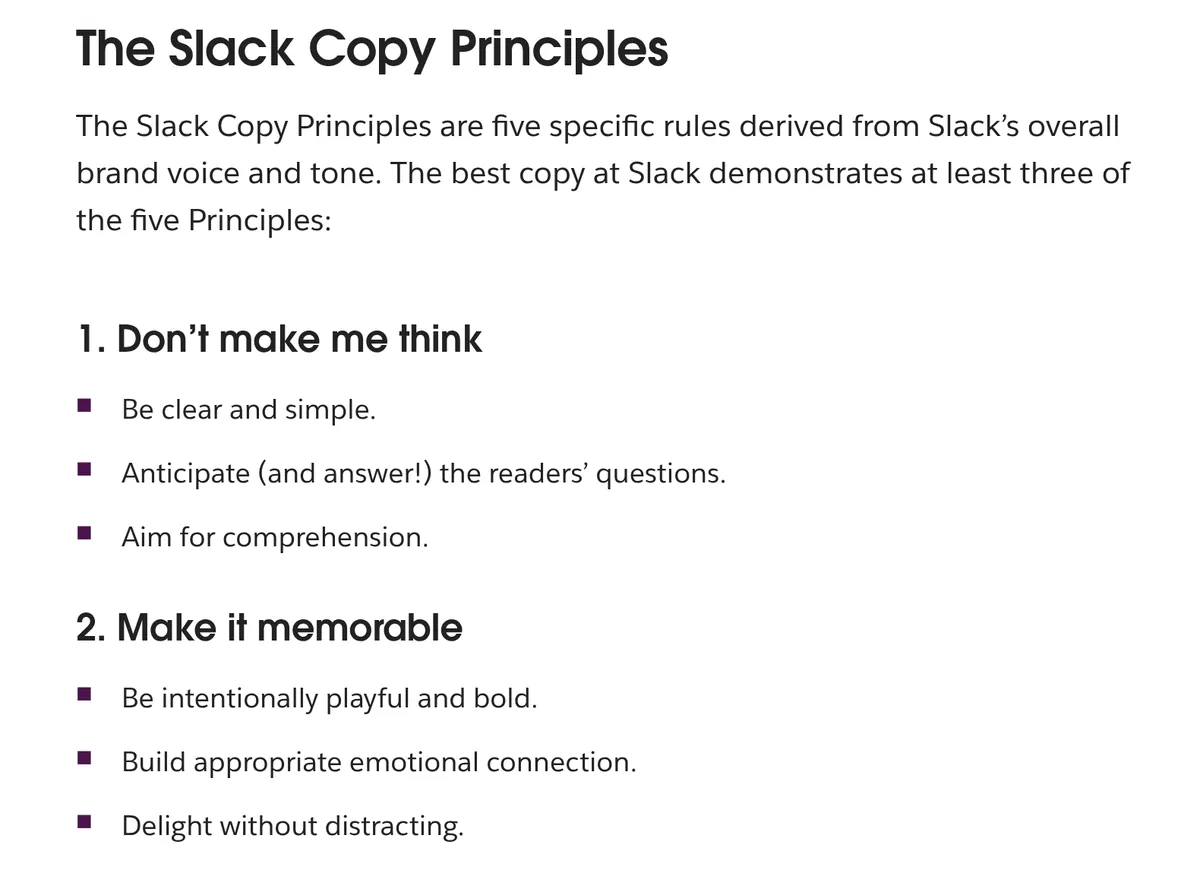
Slack Design, “The voice of the brand”, captured November 16, 2026
The decision is a pass mark. A reviewer can count principles where they can only argue about adjectives. As a rule for an agent: before returning copy, name the principles it shows and the line that shows each, and revise it if there are fewer than three.
Innocent
Innocent, the smoothie maker, shows its voice on its home page:
People say we’re weirdly obsessed with fruit and veg. We prefer to think of it as a healthy obsession.
We’ve built ourselves a factory over in Rotterdam that’s designed to be powered by renewable energy. It’s got solar panels and everything.
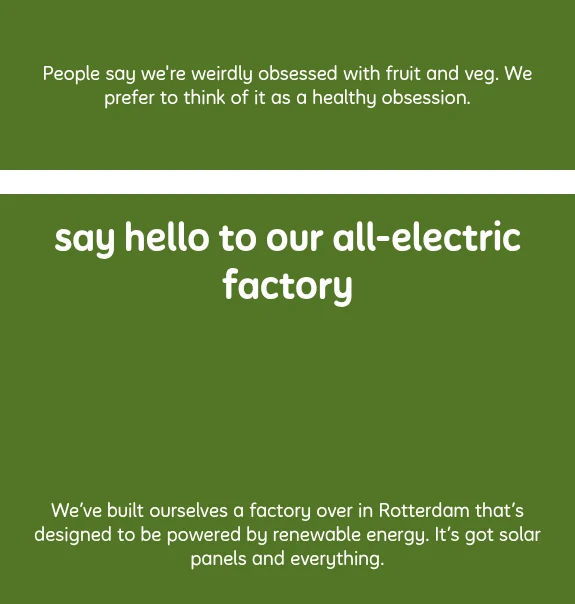
Two cards on Innocent’s home page, each turned over by hovering, captured November 16, 2026
Each joke follows a plain sentence, and the fact it follows is left alone: the factory is still “designed to be powered by renewable energy”. As a rule for an agent: state the fact in one plain sentence first. If you add a joke, make it one short sentence after the fact, and never change the fact to make it funnier.
Apple
Apple’s Human Interface Guidelines, which it publishes for anyone designing apps for its devices, settle two everyday choices:
Prioritize clarity and avoid the temptation to be too cute or clever with your labels. For example, just saying “Send” often works better than “Let’s do it!”
Avoid using we altogether because it may be unclear who the “we” in question refers to.
Its example replaces “We’re having trouble loading this content.” with “Unable to load content”. As a rule for an agent: label each button with the verb for its action, and write errors about what failed, without “we”.
Visa
Visa’s product design system gives its voice three qualities, “active, readable, and human”, then a default:
In general, we recommend a neutral tone that’s straightforward and direct.
It allows four other tones, each tied to situations and shown with an example line: celebratory for success and task completion (“Success! Your account has been created.”), supportive for instructions and support, professional for errors and alerts (“Something went wrong while processing your transaction. Try again in a few moments.”) and welcoming for first-time use. Five tones are ruled out: accusatory, complex, patronizing, robotic and vague. As a rule for an agent: write in a neutral, direct tone, and change it only for the situations on the list, matching the example line given for each.
Oatly
Oatly, the oat drink company, writes even its cookie notice in its own voice. On its US site, the notice opens:
We know you didn’t come here for cookies
But they’re good if you want our site to work correctly. If you want it to work perfectly, choose “Accept all.” If you don’t like being an anonymous statistic or having ads tailored for you, you might want to make some choices.
The heading is the joke. The sentences after it still say what each choice does, and the rest of the notice explains each kind of cookie in plain terms. As a rule for an agent: write required notices in the brand voice too, but state every choice and what it does.
Nike
Nike’s company site opens with a headline that names who it serves, from kids and pros to beginners and rebels, and ends on athletes, with a footnote:
WE SERVE ATHLETES*
*If you have a body, you are an athlete
Many readers wouldn’t call themselves athletes. The footnote keeps Nike’s word and widens it to include them, in one short line. As a rule for an agent: when the brand’s key word could leave readers out, keep the word and define it in one line that lets them in.
Eight published voice guides
| Guide and audience | Rule and how to apply it |
|---|---|
| Mailchimp, its content | Clarity takes priority over humour. Freddie, its mascot, never speaks. Name the priority when traits conflict, and give explicit limits. |
| GOV.UK, government content | Use familiar words and explain specialist terms the first time. Its replacement list keeps technical exceptions: “deploy” stays for software and military contexts. Give replacements and exceptions together. |
| Microsoft, products and content | Replace “If you’re ready to purchase Office 365 for your organization, contact your Microsoft account representative” with “Ready to buy? Contact us.” Show an actual edit and explain what improved. |
| Google, developer documentation | Place a recommended sentence between versions that are too informal and too formal. Show the acceptable range for traits such as “conversational”. |
| Atlassian, interfaces | Vary tone by audience and message type, and think about how often someone sees a message: “Once may amuse, but a dozen times may annoy.” Save playful touches for one-off moments such as success messages. |
| Shopify, admin apps | Confirm a routine action with “Product saved”. Explain the impact and next steps for serious problems. Choose tone from the observable situation, without assuming the reader’s mood. |
| Monzo, bank communications | “It’s never ‘We’d like to apologise’, it’s ‘We’re sorry’.” Its channel guide turns warm wit off for operational messages and customer service. State the level by channel, then show what each level means. |
| Adobe Spectrum, product interfaces | Three voice principles (rational, human, focused) and a tone spectrum with a frequency for each tone: instructive often, helpful and reassuring occasionally, motivational and supportive rarely. A frequency is a rule an agent can follow. |
Keep the guide’s audience in mind. A rule for an error message does not show how a whole article should develop. If you use named traits, explain them too: Monzo’s “everyday magic” means a welcome touch in the experience, rather than magical vocabulary.
Tone by channel
The same voice sounds different on a home page and in an error message. The examples are quoted from the brands and guides above; the middle column is ours.
| Channel or message | What changes | Example |
|---|---|---|
| Home page | One joke, after the fact | Innocent: “It’s got solar panels and everything.” |
| Cookie notice | A joke, then every choice explained | Oatly: “We know you didn’t come here for cookies” |
| Success message | A short celebration | Visa: “Success! Your account has been created.” |
| Routine confirmation | Two words, nothing extra | Shopify’s app guidelines: “Product saved” |
| Error | What failed, without “we” | Apple’s guidelines: “Unable to load content” |
| Apology | Plain and direct | Monzo: “We’re sorry” |
Resolve conflicting rules for your audience
These guides disagree on useful details:
- Google recommends “don’t”, because a scanning reader can miss a separate “not”.
- GOV.UK avoids negative contractions, because readers can misread them.
- Microsoft includes “let’s” in its recommended contractions; Google’s tone guide discourages it.
- Apple tells app writers to avoid “we” in interface text; Monzo apologises with “We’re sorry”. Apple is writing labels and errors inside an app, where “we” is unclear. Monzo is a bank apologising for its own mistakes.
Choose the rule that serves your readers and record the reason. Copying all the rules would give an agent conflicting instructions.
Borrow four patterns for your voice guide
Each of these turns a trait into something an agent can apply and a reviewer can check:
- “X, but not Y” pairs. Mailchimp is “weird but not inappropriate” and “smart but not snobbish”; Shopify tells writers to “be real, but not too tough or overly familiar”. The second half marks where the trait stops.
- Replace this, with this. Microsoft’s guide is a list of before-and-after edits, each showing the change its rule asks for.
- How often a tone appears. Adobe’s frequencies tell an agent that encouragement is the exception, so it doesn’t end every message with one.
- Levels by channel. Monzo sets each trait’s level for each channel, so the same voice writes a push notification differently from a social post.
A voice chart to copy
A “We are / We are not” chart applies the first pattern to each trait. This one is put together from the brands and guides on this page. Replace the lines with your own traits, and keep the limits as specific as these:
- We are clear. We are not cute or clever with labels. (From Apple’s interface guidelines)
- We are weird. We are not inappropriate. (Mailchimp)
- We are smart. We are not snobbish. (Mailchimp)
- We are real. We are not too tough or overly familiar. (From Shopify’s app design guidelines)
- We are conversational. We are not too formal, too casual or robotic. (Visa)
- We are funny after the facts. We are not funny about them. (Ours, from Innocent’s copy)
A mini voice guide, filled in
Son of a Tailor makes T-shirts and shirts in custom sizes. The Rainbrand Brief that Codex received for its cotton guide asked for “calm confidence and an informed, approachable voice”, “clear, compact explanations grounded in the specific garment” and no inflated claims, and kept two sizing offers apart. Here is how we would write that guidance as a voice guide with the patterns above. Lines marked “ours” are our additions, not the brand’s:
## Voice (example built from Son of a Tailor's Brief)

### Calm and confident, but never inflated
- Explain quality through the garment: fibre, weight,
  drape, texture, construction and practical wear.
- Avoid inflated claims.
- Replace this (ours): "The best T-shirt you'll ever own."
- With this, from the cotton guide Codex made:
  "A little more weight changes how it falls, how it
  holds its shape, and how it feels on you."

### Informed and approachable, but compact
- Use clear, compact explanations.
- Ours: name the specific detail rather than praising it.

### Tone by situation (ours)
- Buying guide: explains the choice, garment first.
- Care insert: practical and short, for someone who
  already owns the T-shirt.

### Claims
- Custom sizing and the 24 pre-engineered sizes are
  separate offers; don't promise an exact fit.
- Mention the Free Remake Guarantee only with current
  terms from the policy page.
That line is from the opening of the cotton guide, a saved example made with that Brief.
Turn an example into your own instruction
For one rule from your own guide, fill this record. Anthropic’s prompting guidance recommends relevant, varied examples and the reason behind an instruction.
Source rule and link:
Audience and message type:
Writing decision this rule settles:
Reason for the choice:
Approved copy showing the rule:
Earlier draft and the edit it needed:
Facts the next task must supply:
Use approved copy and explain the edit. If the source gives only a trait, test a proposed instruction before adopting it. Keep changing facts separate so an old example does not supply a new message’s diagnosis, price or date. For a whole guide, fill the worksheet in our voice-guide tutorial, which repeats a record like this for each rule and adds tone by situation, vocabulary and examples by format.
Ask an agent to identify the gaps:
Read our brand voice guide. For each trait, identify its scope, practical rules, reasons, examples and any priority when rules conflict. Quote the source passage for each finding. Flag adjectives that still leave the writing decision open. Draft proposed additions separately, using our own approved copy where available. Do not treat a proposed example as an existing brand fact or change the maintained guide yet.Keep the source and the rule together
Keep each rule linked to its source and your own example. Rainbrand maintains brand context that connected agents can use:
- New brand: add the guide as a source and wait until the brand is ready.
- Existing brand: prepare an edit, inspect and refine the proposed changes, then apply or discard them.
Once the brand is ready, or after applying an update, request a new Brief, the guidance and files for a task. Name its audience, channel and situation so the relevant tone rules can be selected.
Start with one recurring disagreement and record its rule, reason and near-miss. The voice-guide tutorial shows how to build and test the rest.
Frequently asked questions
How many voice traits should a brand have?
Three or four, in the guides above: Adobe, Monzo and Visa each have three, and Mailchimp and Shopify have four. With more, traits tend to overlap, which leaves a writer, or a model, unsure which one decides a sentence.
Can AI learn our brand voice from examples?
Partly. A model copies what it can see in examples, such as sentence length and word choice, but it can’t tell which features matter or where a trait should stop. Give it the rule and the reason alongside approved and rejected examples, then check drafts against each rule rather than asking whether they sound right.
Where should a voice guide live so every AI tool uses it?
In one maintained place that each tool reads for the task, rather than copied into every project and custom instruction. Keeping AI writing in your brand voice covers setting that up across Claude, ChatGPT and other tools.
More in Brand voice
5 min read
How to keep AI writing in your brand voice across tools
ChatGPT, Claude, Gemini, Jasper and your own agents each bring their own defaults, settings and copy of your guide, so one voice comes out several ways. Write the voice in the parts that carry across models, keep one version every tool reads, and check the same tasks in each tool.
6 min read
How to write brand voice guidelines AI tools can follow
Build a voice guide from real edits, with rules, examples, tone by situation and a worksheet you can test on your agents' writing tasks.